SyteLine includes CRM functionality.
But for many manufacturers, the sales organization wants something different.
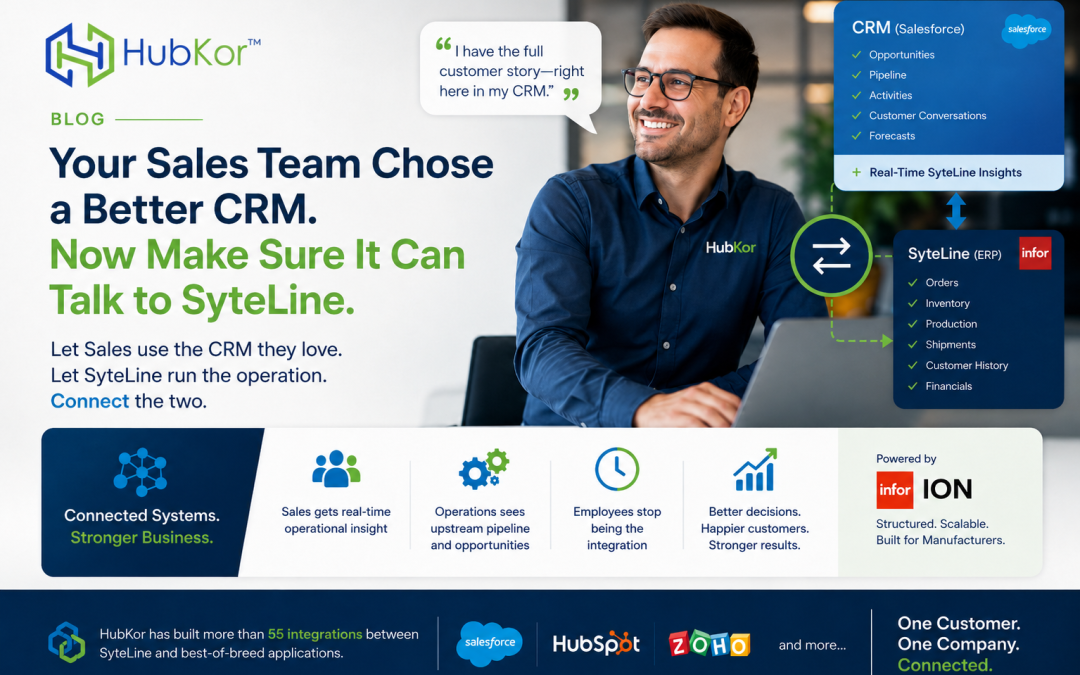
Sales teams often prefer dedicated CRM platforms such as Salesforce, HubSpot, Zoho, or other best-of-breed applications designed specifically around prospecting, opportunities, pipeline management, customer communication, and sales activity.
There is nothing wrong with that.
In fact, we believe manufacturers should use the CRM that works best for their sales organization.
The problem begins when that CRM becomes disconnected from SyteLine.
Then Sales and Operations start working from two different versions of the customer.
And that creates an entirely new set of problems.
Sales Has CRM. Operations Has SyteLine.
Consider what each side knows.
The sales team may have visibility into:
- Leads
- Opportunities
- Pipeline
- Customer conversations
- Activities
- Follow-up tasks
- Forecasts
- Contacts
- Upcoming deals
Operations may have visibility into:
- Actual customer orders
- Inventory
- Production status
- Backlog
- Shipments
- Pricing history
- Returns
- Customer credit
- Open orders
- Delivery performance
Both teams are talking about the same customer.
But they may be looking at completely different information.
That disconnect becomes especially noticeable when the salesperson speaks with the customer.
The customer asks:
Has my order shipped?
Do you have this item available?
What happened with the order I placed last week?
Can you meet the delivery date we discussed?
What have we purchased from you historically?
If the salesperson has to stop the conversation, contact Operations, search through another system, or promise to call the customer back, the CRM is only telling part of the story.
A CRM Should Not Become Another Information Island
A dedicated CRM can be an excellent tool for Sales.
But CRM should not isolate the sales organization from the rest of the company.
That is particularly important in manufacturing.
A sales commitment can affect:
- Inventory
- Purchasing
- Production capacity
- Scheduling
- Shipping
- Pricing
- Customer service
- Cash flow
Sales does not operate independently from Operations.
The systems supporting those teams should not either.
Let Sales Use the CRM They Want
At HubKor, we do not believe manufacturers should force their sales teams into an ERP CRM simply because it happens to be included with the ERP.
If Salesforce is the right platform for your sales organization, use Salesforce.
If HubSpot is the right platform, use HubSpot.
If Zoho is the right platform, use Zoho.
The question should not be:
Should Sales use CRM or SyteLine?
The better question is:
How do we let Sales use the CRM they prefer while keeping them connected to the operational information inside SyteLine?
That is where integration becomes critical.
HubKor Connects Best-of-Breed CRM to SyteLine
HubKor has developed prebuilt, deep integrations between SyteLine and leading third-party CRM platforms.
The goal is not simply to move a customer name from one database to another.
The goal is to connect the information Sales and Operations need to work together.
Depending on the CRM and business requirements, that can mean making important SyteLine information available to the sales organization while keeping appropriate CRM information synchronized with the ERP environment.
The salesperson stays in CRM.
Operations stays in SyteLine.
But the information can move between them.
That is a fundamentally different experience from maintaining two independent systems.
Give Sales More of the Customer Story
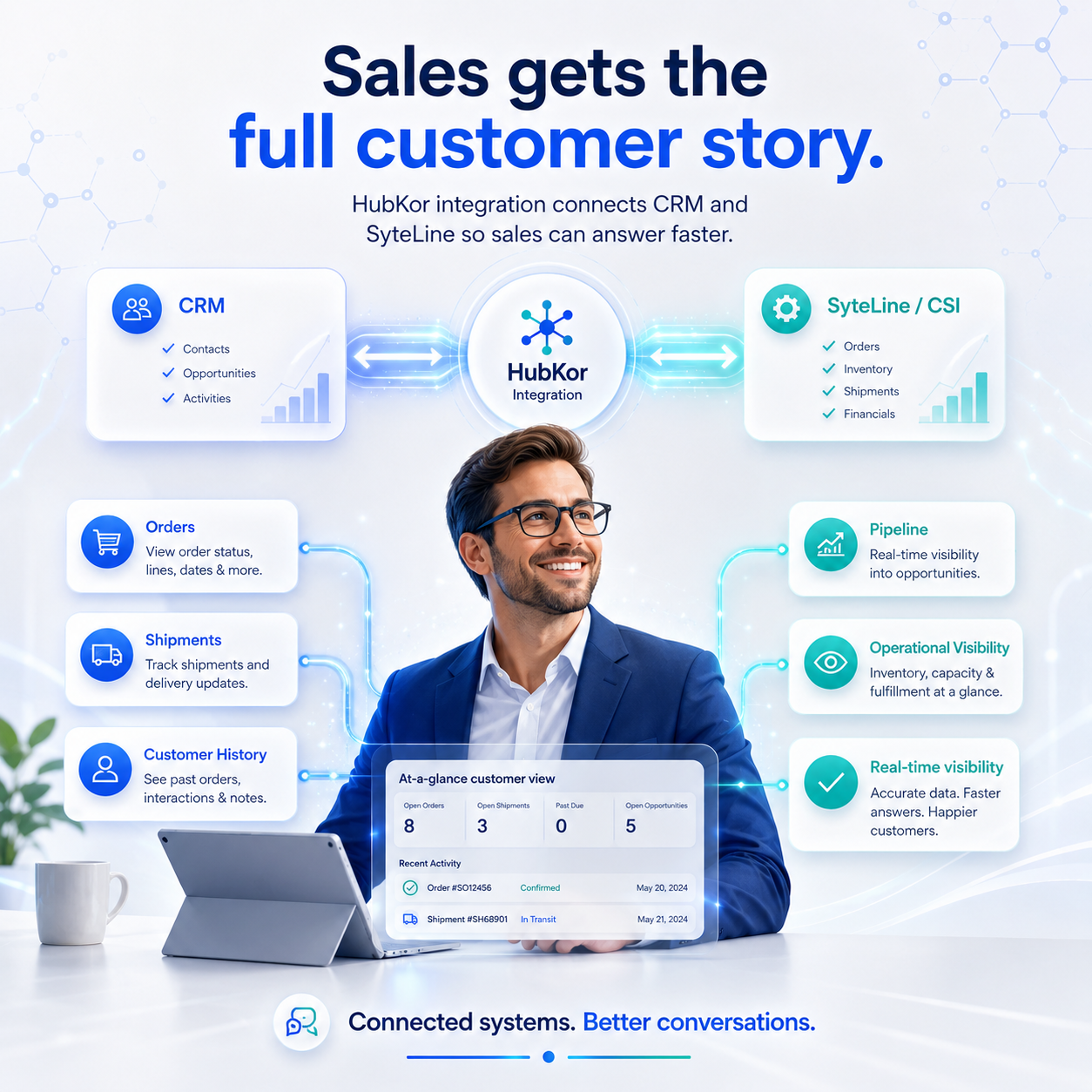
A salesperson should be able to understand more than what is happening before the sale.
Once the customer begins doing business with the company, some of the most important information comes from the ERP.
Orders.
Shipments.
Purchasing history.
Open transactions.
Operational status.
That information can make CRM significantly more valuable.
Instead of CRM being only a record of what the salesperson has done, it becomes a window into what the entire company is doing with the customer.
Imagine preparing for a customer call and being able to see both the sales relationship and relevant operational activity.
The conversation changes.
The salesperson is better informed.
The customer receives faster answers.
And Sales becomes more connected to the actual customer experience.
Give Operations Better Visibility Too
Integration is not only about giving Sales access to ERP information.
Operations can also benefit from understanding what is happening upstream.
A large opportunity may affect planning.
A salesperson may be working on a deal that requires special lead times.
A customer may be considering a significant increase in volume.
Important account information may exist in CRM before an order ever appears in SyteLine.
When systems are connected appropriately, the business has a better opportunity to share information before it becomes urgent.
Stop Making Employees Be the Integration
Without system integration, employees frequently become the integration.
They copy information from CRM into SyteLine.
They send emails between departments.
They create spreadsheets.
They make phone calls.
They enter the same customer information multiple times.
They ask someone in another department to look something up.
All of that consumes time.
It also introduces delays and errors.
A connected CRM and ERP environment reduces the need for employees to manually carry information from one system to another.
Why ION Matters
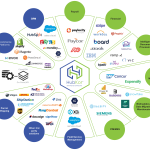
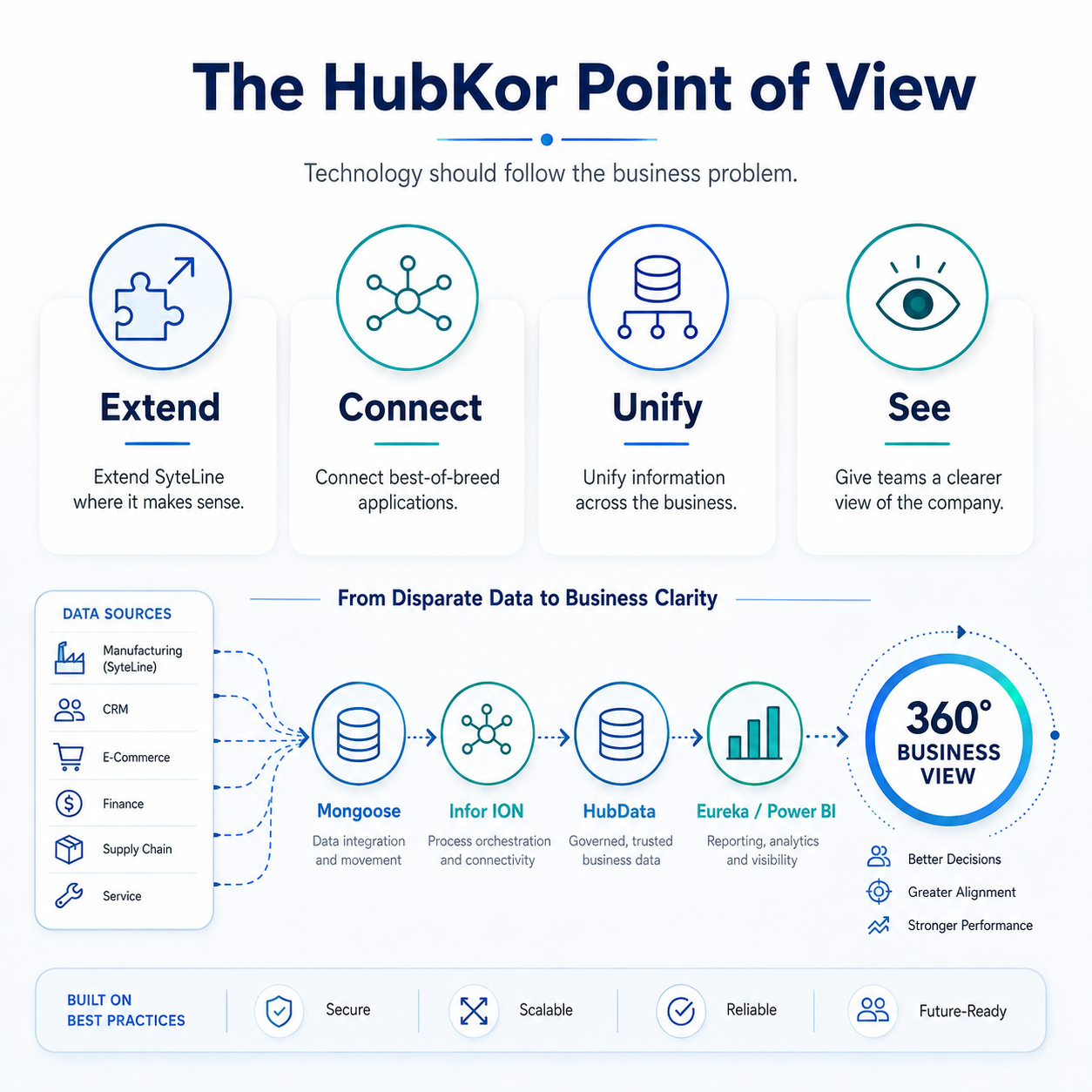
HubKor uses Infor ION to connect best-of-breed applications with SyteLine.
ION is the same integration framework Infor uses across its own product ecosystem, including applications such as Factory Track and CPQ.
For manufacturers, this provides a more structured approach to connecting SyteLine with outside applications than relying on a collection of one-off custom interfaces.
HubKor has built more than 55 integrations between SyteLine and specialized third-party applications.
CRM is one of the most important examples of our overall philosophy:
Choose the application that is best for the user. Then connect it to the rest of the business.
Sales Shouldn’t Have to Choose
Sales should not have to choose between a CRM experience they like and access to operational information.
Operations should not have to move into CRM simply because Sales uses it.
And management should not have to accept two disconnected versions of the customer.
You can allow each team to work in the application that fits its job while still creating a connected business process.
For CRM, our philosophy is straightforward:
Let Sales choose the CRM. Let SyteLine run the operation. Connect the two.
One Customer. One Company.
Your customer does not know that Sales uses one application and Operations uses another.
And they should not have to.
When they speak with your salesperson, they expect that person to understand what is happening with their business.
When they speak with customer service, they expect the same.
When an order moves into Operations, the company should not suddenly lose the context that existed during the sales process.
The applications may be different.
The customer is the same.
That is why CRM integration is about more than moving data.
It is about helping Sales and Operations operate as one company around the customer.
One customer. One company. Connected systems.